
The Cost of Caring: When Selflessness Turns Self-destructive
The Trouble With Altruistic Responsibility

A gifted surgeon gave up a six-figure salary to serve in one of the world’s most underserved regions. She felt a divine calling to bring healing where few others could. But days after arriving, her promised mentor left. Alone and overwhelmed, she became the only medical provider for a community facing devastating need. When asked why she didn’t rest, she answered:
“If I take a break, people die.”
This is not simply burnout. It is the internalization of a belief system in which exhaustion is equated with faithfulness and to rest means failure. It’s a manifestation of what we might call altruistic responsibility—when the desire to serve becomes debilitating for the server.

Altruism and responsibility are admirable traits. But when someone begins to take ownership over outcomes that are not within their control—such as whether others heal, thrive, or survive—compassion becomes compulsion.
Caregivers for chronically ill family members, faith leaders, educators, social workers, and humanitarian workers are particularly vulnerable to this pattern. People in these roles are more likely to take on not just the task of supporting others, but the outcome of others’ wellbeing. The complexities of holistic human need—mental, physical, emotional, spiritual—quickly become overwhelming and unsustainable.
The Psychology and Physiology of Burnout
Psychological research on empathy-based distress shows that chronic exposure to the suffering of others without adequate emotional regulation leads to severe burnout.[1] Studies have demonstrated that individuals with high levels of empathic concern—those who deeply feel the pain of others—are at greater risk of anxiety, depression, and physical health issues linked to stress.[2]
Neuroscience reveals that our brains are wired for connection and self-preservation. The stress response is meant to be temporary, not sustained. When it is chronically activated due to excessive caregiving, the nervous system becomes dysregulated.[3]
For those in caregiving roles, prolonged exposure to trauma can lead to emotional exhaustion and moral injury—wounds to one’s ethical and moral identity from not doing something you believe you should have, or doing something you believe you shouldn’t have, with devastating results.[4]
One of the earliest symptoms of burnout is the erosion of joy. Work that once brought purpose now breeds dread and individuals may blame themselves for feeling disconnected or bitter, interpreting their depletion as a failure of character rather than a signal of impending collapse.
This is especially true for individuals who feel unable to alleviate the suffering of others despite their best efforts. The gap between intention and outcome fuels feelings of guilt, despair, and self-recrimination. Caregivers begin to tie their self-worth to their ability to produce healing or change. When that fails, the blow is not just professional—it is spiritual and existential.
The Trap of Perfectionism and the Savior Complex
Perfectionism often accompanies the altruistic mindset. People in caregiving roles frequently set impossibly high standards for themselves: flawless caregiving, unwavering presence, limitless emotional bandwidth. When these ideals go unmet—as they inevitably do—what follows is a deep sense of inadequacy and moral failure.
This is closely linked to the savior complex: the belief that one’s effort alone can determine the wellbeing of others. While rooted in compassion, this can actually be a subtle form of egocentrism. The savior complex assumes that the world’s healing rests on the back of one’s individual labor. It undervalues the agency and resilience of those being helped and discounts the necessity of communal care.
The result is often both burnout and disempowerment—helpers collapse under the weight and those they serve are denied the transformational value of participation in their own healing.
Digital Overexposure and Cultural Narratives of Self-Sacrifice
In the digital age, this burden has only grown. Constant exposure to crises through social media reinforces the belief that we must care about everything, all the time, and act immediately. The emotional and psychological bandwidth required to respond to this flood of suffering is beyond what most humans can sustain. The result is compassion fatigue and a growing sense of helplessness.
Compounding this is the cultural and religious glorification of self-sacrifice. In many helping professions—and particularly in faith-based environments—working through exhaustion is rewarded, while rest and boundary-setting are viewed with suspicion. The belief that true service requires personal diminishment remains stubbornly persistent.
Sustainable Altruism and the Restructuring of Values
The solution is not to abandon compassion, but to restructure the value system that surrounds it.
Restructuring necessarily begins with rejecting the false dichotomy between self-care and service. Boundaries are not obstacles to compassion; they are the scaffolding that supports it. Saying no is not an act of withholding love—it is an act of stewardship.
Sustainable altruism also requires redefining success. When success is measured by the number of hours worked or the depth of exhaustion endured, burnout is inevitable. A healthier measure values presence, sustainability, and integrity over mere productivity.
Finally, we must disarm the savior complex. Service is not meant to be a solo endeavor. When we overvalue our own role in the care and support, healing and recovery of others, we undervalue their contribution and disrupt the natural reciprocity of human relationships. Just as ecosystems thrive through interdependence, so too must our models of care.
A restructured value system must prioritize rest without guilt. Culturally, rest is often equated with laziness or stagnation. Spiritually, it is frequently minimized or even overlooked. Yet just as the body cannot function without sleep, the soul cannot function without reflection. Rest is not an indulgence; it is an act of alignment—honoring one’s limits, acknowledging one’s humanity, and recognizing that even sacred callings require Sabbath.
This is not selfishness. It is reverence. It is a commitment to being present for others without destroying oneself in the process.
Reflection Questions
How have cultural narratives around sacrifice and exhaustion shaped your own approach to work and service?
What does “sustainable altruism” look like for you personally and in your community or workplace?
How do you currently define “good work,” and how might that definition shift if sustainability and presence became central values?
Reflect on a time when rest, delegation, or self-care felt like strengths rather than weaknesses. How did that affect your effectiveness and well-being?
What systemic changes at the organizational or community level would support you and others in practicing generosity without burnout?
How can you begin to give in ways that honor interconnectedness and preserve your well-being for the long term?
True generosity is not about pouring yourself out until you are empty. It is about creating rhythms where love flows in both directions.
References
[1] Figley, C. R. (1995). Compassion Fatigue: Coping with Secondary Traumatic Stress Disorder in Those Who Treat the Traumatized.
[2] Decety, J., & Jackson, P. L. (2004). The Functional Architecture of Human Empathy. Behavioral and Cognitive Neuroscience Reviews.
[3] McEwen, B. S. (1998). Protective and Damaging Effects of Stress Mediators. New England Journal of Medicine.
[4] Litz, B. T., et al. (2009). Moral Injury and Moral Repair in War Veterans: A Preliminary Model and Intervention Strategy. Clinical Psychology Review
Resource Library:

For the Scholar (Heady, academic research for those who enjoy it.)
THIS article highlights the research of Dr. Barbara Oakley in her study of what she terms “pathological altruism.”
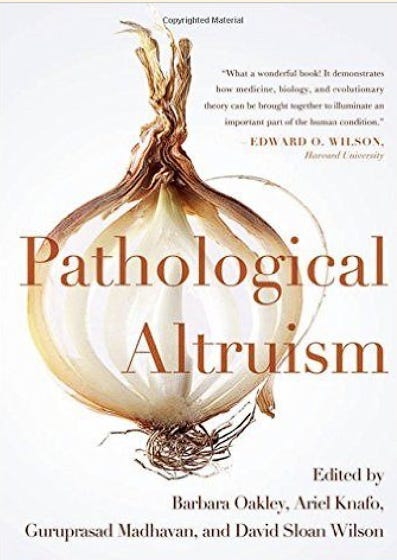
Enjoy this FREE INTRODUCTION to her full length book, Pathological Altruism. The full book can be purchased through her WEBSITE.
For the Care-giver (Digging deeper into caring for people, including ourselves.)
THIS VIDEO “The Dark Side of Helping Others: 13 Surprising Ways It Can Harm You” helps explain some of the pitfalls of hyperactive altruism, emphasizing the need for self-care in the midst of doing good.
For Fun
Enjoy the insight in this short video: The Hidden Truth Behind Being Overly Generous